

Supreme Court Rules for Domashenko!
June 24, 2006
____________________________________________________________________ Hmm -- in the mail today, an official-looking letter from Supreme Court Justice Ruth Bader Ginsburg:
"Dear Mr. Brookes," she writes. "I read with particular pleasure your review of the final performance of La Clemenza di Tito. I attended the opening performance and was captivated by Marina Domashenko's splendid performance. She made it Sesto's opera, no small thing given the stilted and silly libretto Mozart set to glorious music. The first Washington Post reviewer, as I recall, did not give Domashenko the rousing Brava she deserved."
Only in Washington. But, yeah, absolutely -- Domashenko rocks! Here's the review Justice Ginsburg is talking about.
 Stephen Brookes
 1 Comment
 Email
Email Print
PrintCooking at the Ospedali
June 24, 2006
__________________________________________________________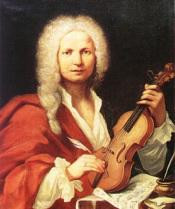
Antonio VivaldiOnly a smallish crowd turned out on Thursday night for the Washington Early Music Festival; maybe due to the 92+ heat, maybe due to some natural limit on the amount of early music one town can absorb in two weeks. The Countertop Ensemble put on a long, somewhat effortful concert, led with great determination by mezzo Marjorie Bunday. We left feeling a bit over-cooked, and drove home in the haze to find Toby barking crazily out the window at the heat lightning. Some kind of metaphor for music criticism? Here's the review:
The Washington Post 6/24/06: One of the most intriguing musical fixtures of the 18th Century was the group of orphanage-conservatories in Venice known as the Ospedali. Set up as havens for abandoned children, they evolved into top-flight music schools for girls, and produced choruses so renowned that composers of the day fell all over each other to write for them.
The result was one of the most extraordinary (and little-explored) treasure-troves of Baroque music in existence, and on Thursday night at St. Mark’s Episcopal Church (as part of the Washington Early Music Festival), the Countertop Quartet and the Baroque Band dove deeply into it. The Countertop is an unusual group; with soprano, mezzo and two high-pitched male counterternors, the group specializes in music for upper voices. Perfect for the Ospedali repertoire, you’d think. And the ensemble gave some fascinating, and at times quite beautiful, readings of works by Nicola Porpora, Antonio Vivaldi, and other composers associated with the schools.
But the concert didn’t quite take off; this is music for light young female voices, and the more spartan, more aged, and definitely more masculine Countertop lacked the sweetness of tone to bring out its full translucent beauty. Despite some thoughtful musicianship, the ensemble also seems to have some teething problems (primarily balancing the voices and achieving a unified sound) and there was a troubling lack of dynamic and textural contrast – crucial to making polyphony like this really sing.
The most convincing piece on the program, in fact, was purely instrumental: Vivaldi’s variations on “La Folia”, Op. 1 No. 12. The Baroque Band – featuring Garry Clarke and Timothy Haig on violins, with Alice Robbins on cello – delivered a riveting, cut-to-the-bone performance, every note crackling with purpose and electricity.
Post-Classical Ensemble's next season; Dolphy solos
June 23, 2006
_______________________________________________________________
Isaac Albeniz at the piano, with his daughter
The Post-Classical Ensemble -- possibly the most thought-provoking small ensemble in the DC area -- has announced its program for the 2006-2007 season, and it's as wide-ranging and interesting as you'd expect. Highlights include an evening of works by Mexican composer Mario Lavista (who'll be there to talk about his music) on November 9; Pedro Carbone performing all four books of Isaac Albeniz’s "Iberia" on November 19; and "Der Abschied" (The Farewell) from Gustav Mahler’s Das Lied von der Erde, set in the context of the traditional Chinese music and poetry that inspired it, on March 16. (A new work by Chinese-American composer Zhou Long will also be premiered.)
_______________________________________________________________
There's an entire universe in Eric Dolphy's soulful, adventurous take on God Bless the Child; this tape (from a 1961 German broadcast) is a master class on what can be done with a solo line. (Caution: Pre-MTV videography.)
Alexandria Guitar Festival, & a little Laurie Anderson
June 22, 2006
____________________________________________________________ The small but intense Alexandria Guitar Festival is coming up next month, just outside of DC; mark your calendar for July 22, when the phenomenal Ricardo Cobo will be playing at The Old Presbyterian Meeting House. His recital last year -- featuring Leo Brouwer's "Black Decameron" -- was a feast of poetry and dark roiling dreams. Other artists in the seven-concert series (which starts July 19) include Stephen Aron, Nicholas Goluses, Julian Gray, Tracy Anne Smith and others.
____________________________________________________________
And, because we've loved her to distraction ever since hearing her unleash the tape-head violin at The Kitchen in, um, 1983? The irresistible Laurie Anderson waltzing with William S. Burroughs and performing "Language is a Virus" from the 1986 film, "Home of the Brave":
It's going to be a long day
June 21, 2006
__________________________________________________________
It's the summer solstice; seems like there are dozens of music festivals around the country getting underway. The great Aspen Music Festival opens today, with a focus this year on (surprise!) Mozart and Shostakovich.
Today's also World Music Day -- but if you knew that already, you probably call it "La Fête de la Musique." It's a quasi-diplomatic concoction of the Government of France, dreamed up in the early 1980's by culture commisar and government hipster Jack Lang. But it's grown from a few concerts in Paris to a major international music event, with concerts in more than a hundred countries around the world -- largely sponsored by France's embassies and diplomatic missions.
"The musicians are asked to perform for free, and all the concerts are free [to] the public," says the Fête's official website. "It’s the reason why they are used to play in open air areas as streets and parks or in public buildings like museums, train stations, castles… Furthermore, the Fête de la Musique is a way to encourage the major music institutions ... to perform outside their usual locations."

La Fete de la Musique in China
OK -- so let's go! Slight problem -- in spite of the fact that there are hundreds of Fête concerts in places ranging from Rangoon -- yeah, Rangoon -- to Madagascar, there's only one single event in the entire United States: the Refugee All Stars of Sierra Leone, playing tonight in Miami and sharing the stage with the French pop group Kid, the Colombian Grupo Naidy and a band playing traditional Haitian music.
So we've been snubbed by France -- ow. But the whole concept of musical diplomacy needs to be kicked around a little more at the State Department. Enough of those dreary little consular libraries with their earnest shelves of Thomas Paine -- music's an infinitely more effective way to get into people's ears. I mean, who ever danced to "Common Sense"? Karen Hughes -- take note!
Roll Over, Titian
June 20, 2006
_________________________________________________________
The National Gallery of Art opened a new mega-exhibit on Sunday called "Bellini, Giorgione, Titian and the Renaissance of Venetian Painting" -- and it's a source, says Post critic Blake Gopnick, of "endless pleasure". Can't personally confirm that; we stayed by the pool all day. Few pleasures, endless or otherwise, in trying to absorb Renaissance subtleties when you're mashed in an opening-day mob.
But the tie-in concert that night by the NGA Vocal Arts Ensemble was a treat; mucho Monteverdi, some very very fine singing, and an appreciative audience. And happy to report that someone down at the NGA finally set up acoustic baffles on the stage; it's still almost impossible to see anything in the West Garden Court, but at least the acoustics have been dried out a bit.
It also warmed my cold and critical heart to see a lot of kids there with their parents -- good going, parents! My own little darlings, of course, were elsewhere. More pressing engagements involving horses, beaches and, if I understand correctly, boys.  Anyway. The always amazing Rosa Lamoreaux heads up the NGAVAE and took a lead role in the performance. Two nights earlier she sang in Francesco Cavalli's seldom-staged 1641 opera "La Didone", which Joe Banno covered for the Post. If you get a chance to hear her in just about anything, don't miss it. Your ears will thank you.
Here's the review:
The Washington Post: Sunday night's concert of Renaissance music at the National Gallery of Art was designed to complement the new exhibit of Venetian Renaissance painting that opened there this weekend. Unfortunately for Titian and the gang, though, the music was so fresh, powerful and compelling in every way that it pretty much stole the show.
Credit for that feat goes to the remarkable Rosa Lamoreaux, music director of the National Gallery Vocal Arts Ensemble and lyric soprano extraordinaire. She assembled a program of works by eight Italian composers from the 16th to early 17th centuries that showcased the explosive creativity of the time -- not just the stylistic innovations but also the remarkable new depths of emotion and dramatic expressiveness.
Chief among the Italians, of course, was Claudio Monteverdi, and Lamoreaux and mezzo Barbara Hollinshead delivered a breathtaking performance of his "Cantate Domino," a virtuosic motet for two voices with viol, theorbo and harp. Much ink has been spilled trying to describe the beauty of Lamoreaux's voice; let's just call it "angelic" and leave it at that. Both she and Hollinshead negotiated this intricate, lavishly ornamented work with ease.
The rest of the program was equally a treat to the ears, from Rossino Mantovano's meltingly sweet "Lirum bililirum," to the sensuous "Il bianco e dolce cigno" of Jacob Arcadelt, to the Monteverdi duet "Zefiro, torna," sung with poignant delicacy by tenors Tony Boutte and Philip Cave. The entire ensemble sang with great elegance, closing the program with a stunning reading of Monteverdi's "Beatus vir," whose surging power and complex drama rang in the ears long after the standing ovation stopped.
Stravinsky's friends
June 17, 2006
__________________________________________________
Arnold Newman
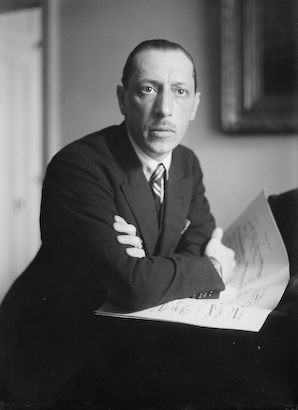
Happy Birthday to Igor Stravinsky, born today in 1882: "My music is best understood by children and animals."